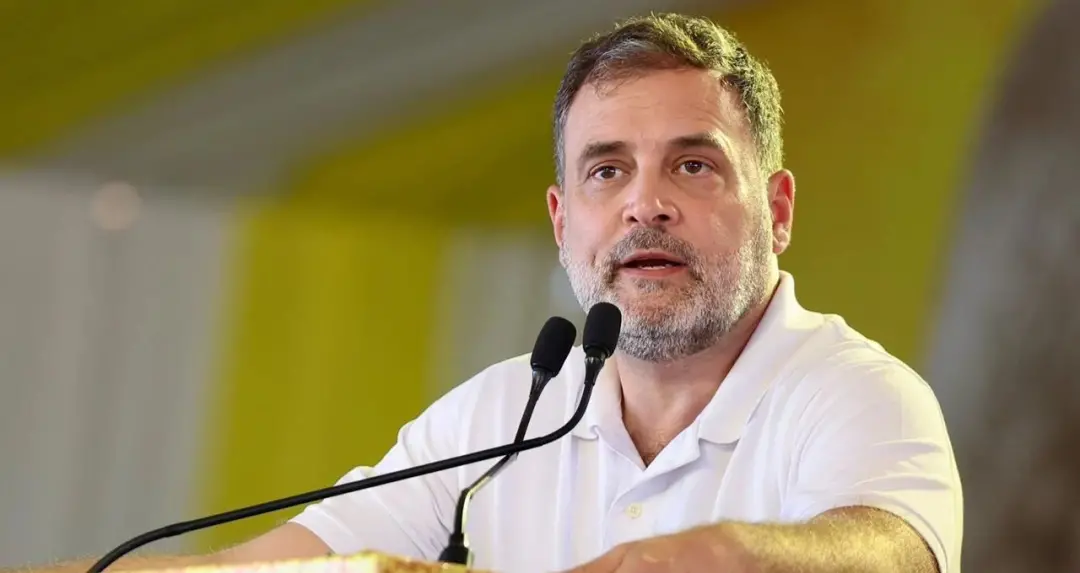
Leader of Opposition in the Lok Sabha Rahul Gandhi has called for the withdrawal of the proposed Merchant Discount Rate (MDR) on UPI and appealed to Prime Minister Narendra Modi to reconsider the decision. Under the new framework of the central government and NPCI, a 0.4% MDR will apply from October 15, 2026, to certain person-to-merchant (P2M) UPI payments above ₹2,000, while customers will not be charged the fee.
Rahul Gandhi released a video message on social media opposing the proposed charge on UPI. Referring to decisions taken by former Prime Minister Indira Gandhi, he said that she had taken decisions firmly even under difficult circumstances.
Rahul Gandhi appealed to Prime Minister Narendra Modi to withdraw the proposed UPI-related charge. He alleged that the government was bowing before the United States and that imposing a charge on UPI would place a burden on Indians.
In a social media post, Rahul Gandhi said the Prime Minister should withdraw the UPI tax. He referred to the proposed charge as a “tax”, while the government has officially clarified that MDR is not a tax collected by the government.
Under the new framework of the central government and NPCI, a 0.4% MDR will apply from October 15, 2026, to certain P2M, or person-to-merchant, UPI payments above ₹2,000. The maximum charge has been capped at ₹300 per transaction.




The charge will not be collected directly from the customer making the UPI payment. According to the government, the MDR will be distributed among participants in the UPI payment ecosystem, including banks, payment service providers and UPI app providers.
This means that no MDR will apply to merchant UPI payments of up to ₹2,000 for ordinary UPI users. Person-to-person (P2P) transactions, irrespective of the amount, will also remain outside the MDR framework.
According to the government, more than 95% of P2M UPI transactions between individuals and merchants are payments below ₹2,000. These transactions will not attract MDR under the new rules.
Separate provisions have also been retained for small merchants. According to the government, small merchants covered under the P2PM category, including street vendors and nearby small shops, that receive up to ₹1 lakh per month through UPI QR will continue to receive the benefit of zero MDR on all transactions.
The government has said the arrangement is intended to prevent additional payment-cost pressure on small businesses.
The new framework provides a separate arrangement for certain essential and low-margin sectors. For sectors such as railways, telecommunications, insurance, fuel and agricultural raw materials, transactions above ₹2,000 will attract a flat fee of ₹5 instead of the 0.4% MDR.
For certain capital-market-related payments, including transactions involving mutual funds, securities, stockbrokers and dealers, the MDR has been set at 0.02%, with a maximum limit of ₹300.
Amid Rahul Gandhi’s allegations, the central government has clarified that MDR should not be treated as a government tax. According to the Finance Ministry, it is a charge within the merchant payment ecosystem that is distributed among the relevant payment-system participants.
The government has also said that customers making payments through UPI will not be charged any transaction fee. P2P payments will remain free without any amount-based limit.
In August 2026, the Finance Ministry had also said that UPI users would not be charged any fee and that, if MDR was implemented, it would apply only to limited categories of merchant transactions.
Under the new rules, eligible P2M transactions above ₹2,000 will attract a 0.4% MDR, subject to a maximum of ₹300 per transaction.
For example, if an eligible customer pays ₹3,000 to a merchant, the MDR at 0.4% would be ₹12. For a payment of ₹50,000, the MDR would be ₹200. For transactions of ₹75,000 or more, the MDR would be capped at ₹300.
The charge is not intended to be recovered from the customer. According to the government, the MDR applies within the merchant-side payment ecosystem.
UPI has become a major part of India’s digital payments infrastructure. According to NPCI data, UPI recorded about 24,508.96 million, or 2,450.896 crore, transactions in August 2026, with a total value of approximately ₹29,82,355.95 crore. The number of banks linked to UPI stood at 752 during the month.
In August 2026, the government said that developing an economic model for the payment system was necessary to make UPI sustainable over the long term, strengthen its technological infrastructure and expand digital payments.
Rahul Gandhi has opposed the proposed MDR framework and called on Prime Minister Narendra Modi to withdraw it. The government, meanwhile, has limited the new framework to specified merchant transactions and clarified that no UPI charge will be collected directly from customers.
The political debate over UPI MDR is centred on how the proposed charge on merchant transactions will affect the digital payments system and businesses. The new rules are scheduled to take effect from October 15, 2026.