
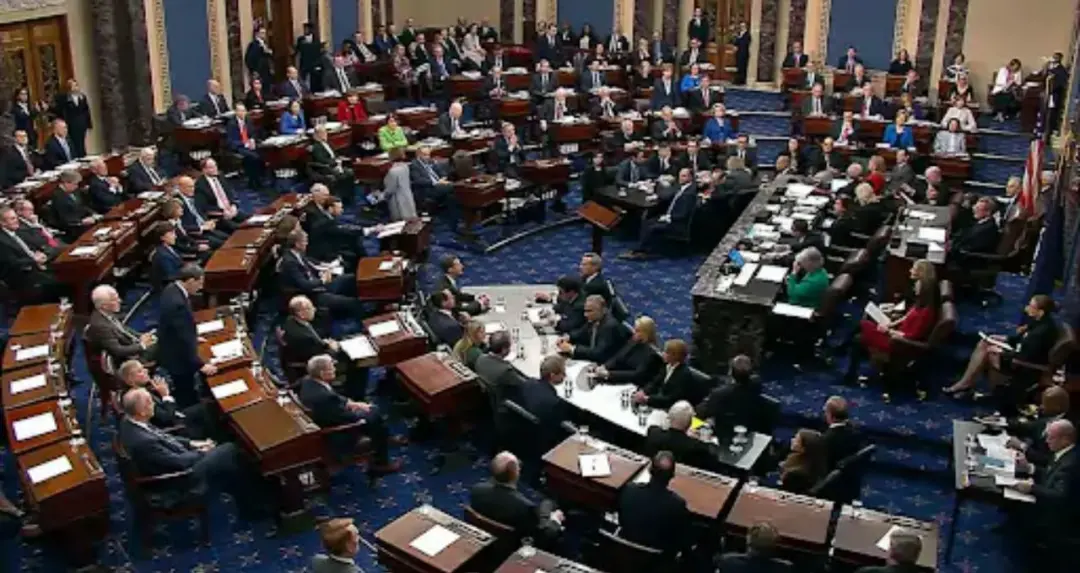
The U.S. Senate rejected a proposal to require congressional approval before any new military action against Iran by a vote of 49-50, providing immediate political relief to President Donald Trump's administration. Republican Senator Dave McCormick of Pennsylvania did not participate in the vote. Opposition lawmakers, however, continue to press for greater congressional oversight of military action.
The proposal sought to ensure that the United States would obtain congressional authorization before launching any new military campaign against Iran. Had it advanced, the President would not have been able to decide on military action independently. However, after failing to secure sufficient support in the Senate, the measure remains stalled in the Foreign Relations Committee. Supporters will now have to follow a new procedural route to bring it back before the full Senate.




Following President Trump's recent airstrikes on Iran, Democratic lawmakers have continued to argue that congressional approval should be mandatory for decisions involving military action. They contend that the Constitution requires Congress to play a role in decisions related to war.
Tensions between Iran and the United States have continued to escalate over the past 24 hours. During this period, two ships caught fire following a drone attack at an Egyptian port, with Iran being accused of carrying out the attack. The U.S. military also conducted large-scale airstrikes in several Iranian locations, including Bandar Abbas, Kish, and Qeshm Island. In response, Iran's Revolutionary Guards claimed they had targeted U.S. bases in Kuwait and Jordan. There were also reports that one employee was killed in an attack on a building belonging to a Chinese company in Kuwait. Meanwhile, Saudi Arabia has initiated efforts to form an international coalition to protect shipping in the Red Sea, with 14 countries expressing interest.
Iran's Islamic Revolutionary Guard Corps (IRGC) said the Strait of Hormuz would remain closed and that a response to the U.S. attacks would be delivered soon. Iranian Parliament Speaker Mohammad Bagher Ghalibaf blamed the United States for civilian deaths on Qeshm Island and said the United States would have to pay the price.
Amid the escalating tensions, international crude oil prices declined on Friday. Brent crude fell about 1.2% to $88 per barrel, while U.S. WTI crude dropped 1.8% to $82.09 per barrel. However, crude oil prices are still projected to have risen by approximately 20% over the course of July.


