
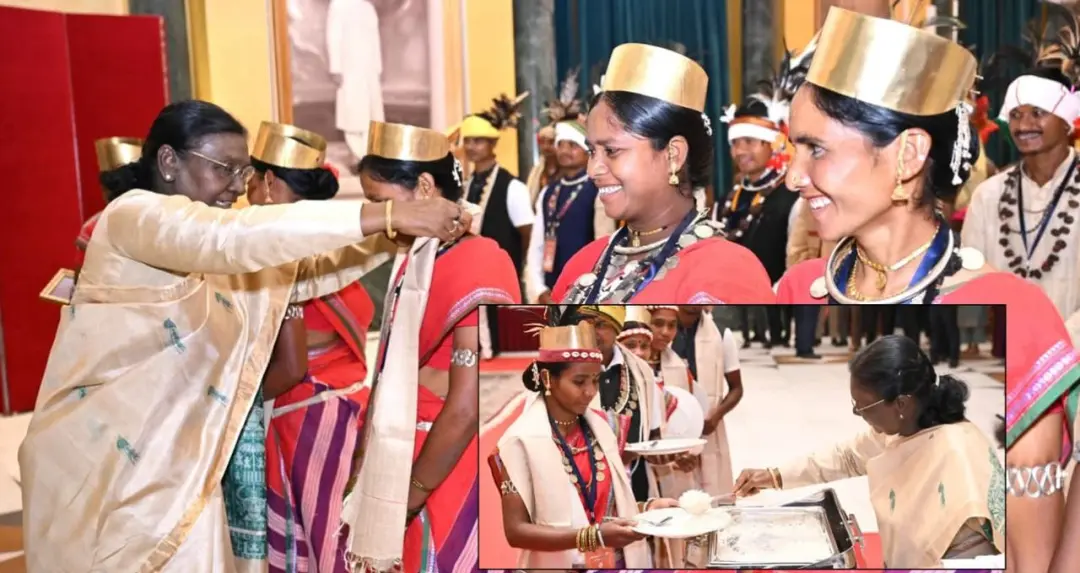
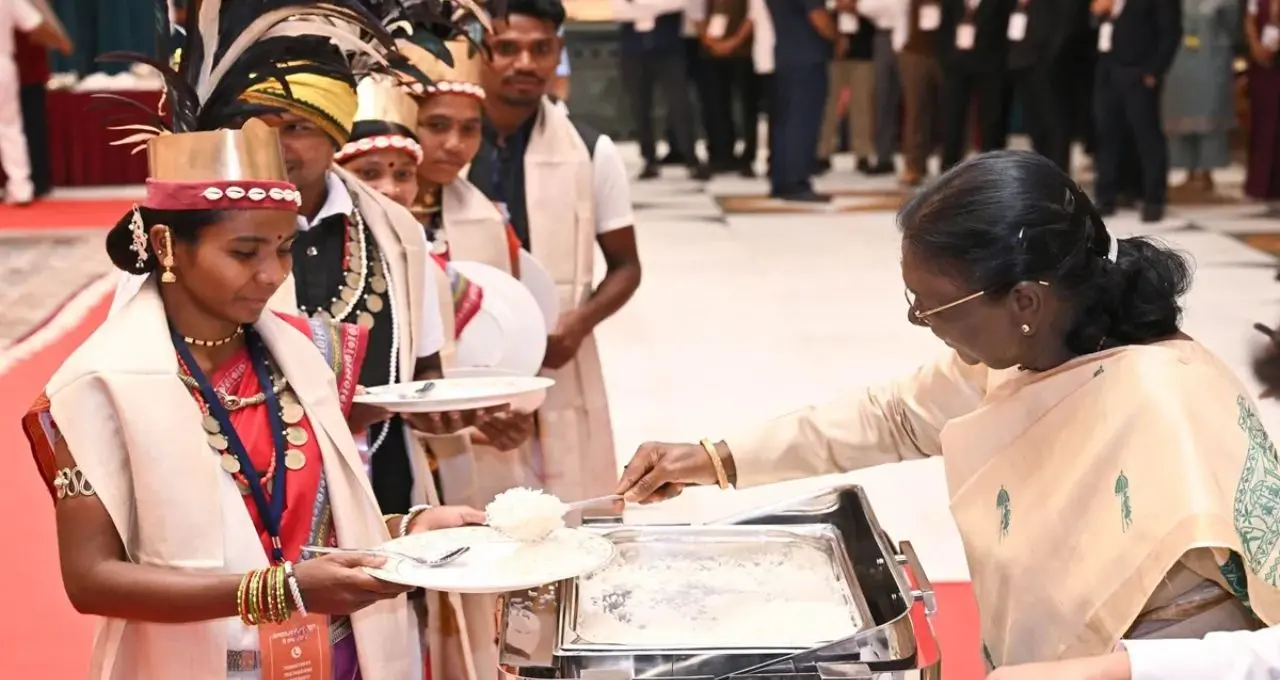
President Droupadi Murmu welcomed a 209-member tribal delegation from the Bastar region of Chhattisgarh at Rashtrapati Bhavan on Friday, where Bastar's traditional tribal culture, folk traditions, and social leadership system were presented at the constitutional complex. According to the source, this was the first time that Bastar's traditional tribal culture, folk traditions, and traditional attire were showcased on such a scale at Rashtrapati Bhavan. During the event, the President personally served food to members of the delegation at a special banquet held in their honour.
The delegation included winners of Bastar Pandum-2026, traditional tribal leaders associated with the Manjhi and Chalki systems, Padma Shri awardees, public representatives, and senior administrative officials. The programme showcased Bastar's cultural heritage on a national platform and highlighted India's cultural diversity and inclusive democratic traditions.
During the interaction, President Murmu held informal discussions with members of the delegation and sought detailed information about Bastar's folk traditions, art, culture, and social structure.

Appreciating the artists, artisans, and traditional tribal representatives, the President said that India's cultural diversity is its greatest strength. She also stated that the heritage and knowledge systems of tribal communities form an important part of the country's cultural identity.
At the request of Chhattisgarh Chief Minister Vishnu Deo Sai, President Murmu expressed her desire to attend cultural events such as Bastar Dussehra and Bastar Pandum in the future. She said that the traditions and cultural beliefs associated with Bastar Dussehra had always attracted her. The President also said that she shares a deep personal connection with the tribal community.
She stated that the Manjhi community is like a family to her and that her own family has also been associated with the tradition.
In her address, President Murmu said that events such as Bastar Pandum play an important role in giving national and international recognition to India's rich tribal culture, folk art, and traditional knowledge. She said such cultural festivals connect young people with their roots and heritage while also promoting tourism, local employment, and regional development.
The President expressed confidence that Bastar's artists, artisans, and youth would continue to contribute to the country's development while preserving their cultural identity.
The President also appreciated the development work taking place in the Bastar region. She said that positive changes are visible with the expansion of basic facilities such as education, roads, electricity, and drinking water. According to her, the participation of local communities and government efforts are helping Bastar move towards peace, development, and prosperity.
She also described the role of traditional social leaders such as the Manjhi and Chalki as important, stating that they serve as a b link between society and the administration while contributing to the preservation of cultural values and traditions.
Union Home and Cooperation Minister Amit Shah said that the presence of such a large tribal delegation from Bastar in traditional attire at Rashtrapati Bhavan reflected India's cultural diversity. Chief Minister Vishnu Deo Sai said that the recognition accorded to Bastar's culture at Rashtrapati Bhavan was a matter of pride for the entire state of Chhattisgarh.
Sai said that Bastar is moving forward with a new identity of peace, development, and cultural revival, and that such occasions provide the region's cultural heritage with greater national and global recognition.
On the occasion, Chief Minister Vishnu Deo Sai presented the President with the renowned Bastar artwork "Jhitku-Mitki." Based on an approximately 300-year-old folk legend, the commemorative artwork is regarded as a symbol of love, dedication, sacrifice, and social harmony. According to Bastar's folk traditions, Jhitku and Mitki hold a place of special respect, and their story continues to be regarded as an important part of the region's cultural identity.


