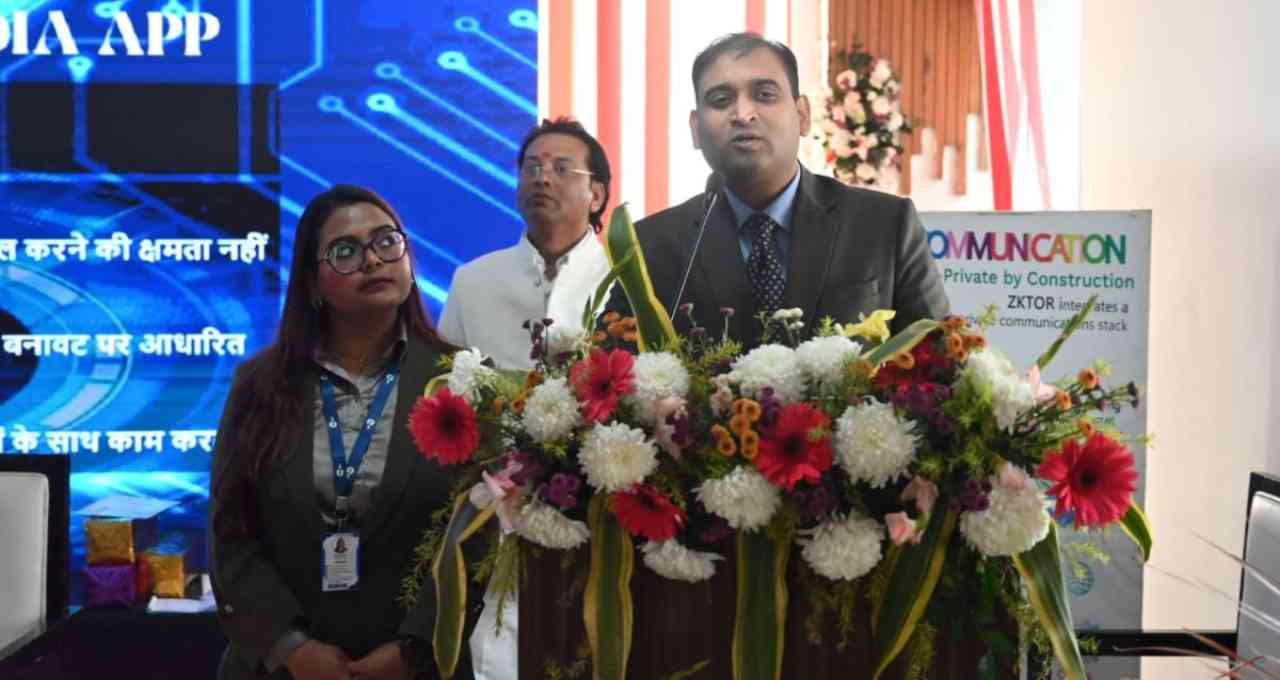
At a press conference in Ranchi on 3 February 2026, Softa Technologies CEO Sunil Kumar Singh presented ZKTOR as a privacy-first social media platform built on zero-knowledge architecture, no-URL media design, and hyperlocal employment models challenging the global logic of data profiling from an Indian context
Ranchi: The global digital economy is reaching an inflection point where convenience and scale increasingly depend on the systematic extraction of human behaviour. Social media platforms, now deeply embedded in everyday life from metropolitan centres to rural towns, operate on a familiar economic logic continuous behaviour tracking, profiling, and large-scale data collection. What began as tools for connection have evolved into systems that observe preferences, emotions, movements, and social affiliations, converting them into commercial and strategic value.
Against this backdrop, a markedly different proposition was articulated on 3 February 2026, when Softa Technologies introduced its social media platform ZKTOR at a press conference in Ranchi, Jharkhand. Rather than announcing another consumer app, the presentation outlined a structural rethinking of how digital platforms are designed, governed, and embedded within society.
Speaking to the media, Sunil Kumar Singh, CEO of Softa Technologies and chief architect of ZKTOR, framed the challenge succinctly: in the digital age, privacy cannot remain a policy promise or a user setting; it must become an architectural rule.
Reversing the Logic of Data Profiling
At the heart of ZKTOR lies what the company describes as a Zero Knowledge Architecture. In contrast to conventional platforms where user content, metadata, and behavioural signals are processed at multiple system layers, ZKTOR is designed so that the platform itself does not possess the technical capability to read or interpret private user content. Even internal engineering teams are structurally restricted from accessing user data.



This design philosophy shifts trust away from legal terms and discretionary safeguards toward mathematical and infrastructural constraints. By limiting what the system can see, ZKTOR seeks to eliminate entire categories of data misuse rather than manage them after the fact. The platform further rejects behavioural tracking and profiling algorithms, distancing itself from feed optimisation models that rely on psychological inference. In doing so, it questions the inevitability of profiling-based monetisation that currently underpins global social media economics.
Women, Safety, and System-Level Protection
One of the most closely examined aspects of ZKTOR is its No-URL media architecture. On the platform, uploaded photos and videos do not generate publicly accessible web links. The absence of URLs significantly restricts the ability to download, scrape, re-upload, or algorithmically manipulate content outside the platform’s environment.
In an era of AI-driven image manipulation and deepfake proliferation where research consistently shows women as the primary targets this architectural decision reframes online safety as a design problem rather than a moderation burden. Instead of relying on reporting mechanisms after harm occurs, ZKTOR attempts to narrow the technical pathways through which misuse can happen.
Data Sovereignty and Regulatory Alignment
ZKTOR’s infrastructure is also designed around region-wise data handling, aligning with the growing global emphasis on data sovereignty. By enabling compliance with local regulatory expectations, the platform reflects the intent behind India’s DPDP framework and the European GDPR, not merely as compliance checklists but as embedded system principles.
This approach has drawn attention in policy circles where questions are increasingly raised about whether future digital platforms must internalise regulatory values at the architectural level rather than retrofit them later.
A Founder’s Journey Across Contexts
The credibility of ZKTOR’s design narrative is closely tied to its creator’s background. Sunil Kumar Singh, born in a small village in what was then undivided Bihar and now closely associated with Jharkhand, spent over two decades working in Finland, a country globally recognised for its rigorous data protection standards, social equity, and engineering discipline.
According to Singh, ZKTOR represents an attempt to translate Nordic principles of precision and privacy into the social, linguistic, and cultural realities of India. The platform’s architecture consciously avoids bypassing local contexts, instead integrating rural participation, regional languages, and cultural diversity into its operational model.
Funding Choices and Independence
Notably, Softa Technologies has chosen to develop ZKTOR without foreign venture capital funding or government grants. Singh explained that this decision was driven by a desire to insulate the platform from market pressures that often push social media systems toward aggressive data monetisation. By remaining self-funded, the company claims greater freedom to prioritise long-term social outcomes over short-term growth metrics. While Singh has described ZKTOR as aligned with the broader vision of India’s digital self-reliance, he has repeatedly emphasised that no direct governmental assistance has shaped the platform’s development.
Employment, Creators, and Hyperlocal Operations
Beyond architecture, ZKTOR introduces an alternative economic model for the creator ecosystem. The platform proposes a 70 percent revenue share for content creators, positioning this as a corrective to opaque monetisation structures prevalent elsewhere.
Its hyperlocal operations framework extends beyond content, envisioning region-specific moderation, community operations, and support roles. According to Softa Technologies, this model is expected to generate employment opportunities across Tier-2 to Tier-4 cities, allowing young people to participate in digital infrastructure without migrating away from their local contexts.

A Platform as a Question, Not a Claim
Currently undergoing mass beta testing across South Asia, including India, Nepal, Bangladesh, and Sri Lanka, ZKTOR is available on both Google Play Store and Apple App Store. Yet, the platform stops short of positioning itself as a definitive solution. Instead, it raises a broader question for the digital future: must social media continue to be built on comprehensive surveillance of human behaviour, or can alternative architectures designed around restraint, dignity, and local participation exist at scale?
As debates around AI governance, data colonialism, and platform accountability intensify worldwide, the ideas presented from Ranchi on 3 February 2026 suggest that the next phase of digital evolution may be shaped not only by technological capability, but by deliberate limits placed upon it.