
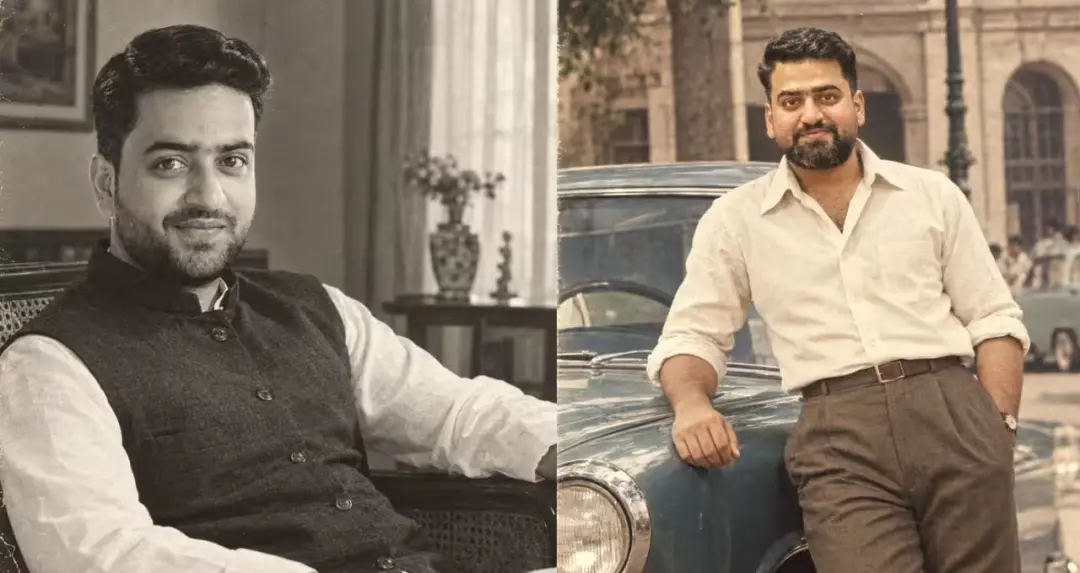
The Vintage Avatar trend is rapidly gaining popularity on social media, with users turning their photos into AI-generated images inspired by different decades. Using prompts with a photo in ChatGPT or Gemini, users can create decade-specific looks ranging from the 1950s to the 2000s.
For a 1950s look, the focus is on simplicity, traditional attire and classic black-and-white photography. The prompt can instruct the AI to preserve the person’s identity, skin tone and natural expression. Men can be shown with neatly groomed hair, a simple shirt, khadi kurta or Nehru jacket, while women can be styled in a simple khadi sari with minimal jewellery and a traditional hairstyle. An old Delhi or Bombay ambience, soft lighting and 35mm film grain can be added to create the period photography effect.


The 1960s style reflects the influence of Indian pop culture and cinema. Men can be given side-parted hair, fitted shirts, trousers and blazers, while women can have bouffant hairstyles, cat-eye eyeliner and churidar-kurta or sari outfits. Old urban areas, vintage cars or studio backgrounds can be used, along with warm colours, light film grain and an analogue photography effect.
The 1970s look is more bold and colourful. Men can be styled with long hair, sideburns, printed open-collar shirts, bell-bottom trousers and large sunglasses. Women can be shown with large-frame sunglasses, voluminous hairstyles, printed scarves and bright saris. Old vehicles or Indian city streets, combined with warm analogue colours and 35mm film grain, can complete the look.
For the 1980s, the focus is on big hairstyles, bright clothing and a filmi style. Men can be given voluminous hair, a coloured shirt, high-waist trousers, sunglasses and a confident pose. Women can have voluminous wavy hair, earrings or jhumkas, a bindi and a colourful salwar suit. Backgrounds such as an old drawing room, TV cabinet or tape recorder can reinforce the decade-specific setting.
The 1990s style is comparatively casual. A denim jacket, loose shirt, casual hairstyle and simple accessories can be used, with backgrounds such as a college campus, railway station, roadside café or open field. Soft focus, warm natural lighting and slightly faded colours can create the desired visual effect.
The 2000s style reflects the increasing influence of global fashion trends in India. Denim, sporty jackets, caps, sunglasses and gel-set spiky hairstyles can be incorporated. Men can be styled in graphic T-shirts, silver chains and cargo pants, while women can have glossy lips, straight hair, butterfly clips and casual outfits associated with the era. A cyber café, arcade or early digital-camera effect can be used for the background and photography style.
To create these images, users can upload a photo to ChatGPT or Gemini and paste the prompt for their selected decade. Specifying identity and natural facial features can help preserve the original person’s identity. The same approach can be used to create a series of decade-specific photos, from the classic 1950s style to the Y2K-inspired 2000s look, which can then be shared on social media.


