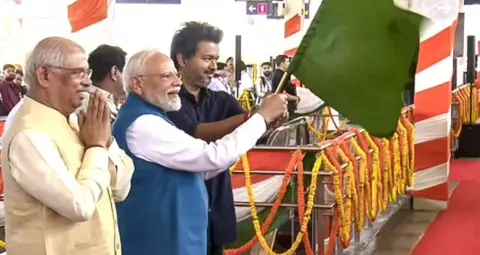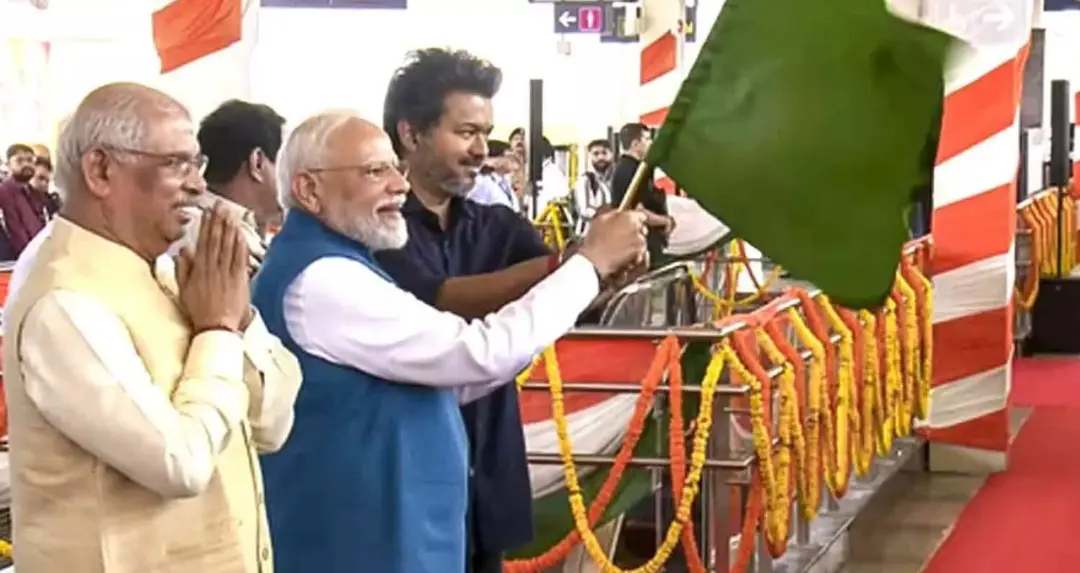
Prime Minister Narendra Modi inaugurated the 14.6-kilometre Poonamallee–Vadapalani corridor under Phase 2 of the Chennai Metro Rail project on Sunday, October 11, 2026. Tamil Nadu Chief Minister Vijay was present at the inauguration, after which the two leaders travelled together on a metro train.
Modi subsequently attended the golden jubilee celebrations of Jayagopal Garodia Hindu Vidyalaya, where he addressed students and urged them to dream big, think differently and remain fearless. He also spoke about India's development, educational opportunities, sports infrastructure and the importance of preserving Tamil language and culture.
The visit was described as the Prime Minister's first trip to Chennai after the 2026 Tamil Nadu Assembly elections. Actor-turned-politician Vijay became chief minister following the victory of Tamilaga Vettri Kazhagam (TVK), with the Congress as its alliance partner. Urban transport, education, youth participation and India's development were among the key themes of the visit.
Modi inaugurated the 14.6-kilometre corridor between Poonamallee and Vadapalani as part of Phase 2 of the Chennai Metro project. The expansion is intended to improve connectivity between different parts of the city and provide commuters with more convenient public transport services.
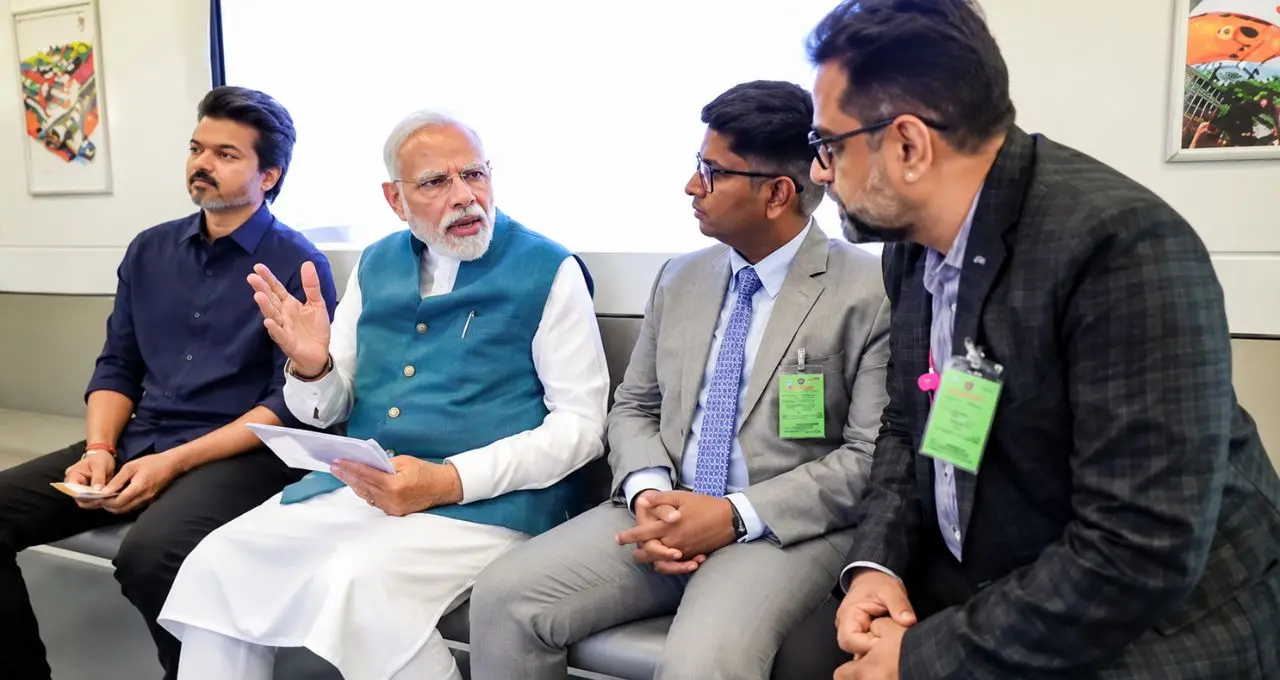
Following the inauguration, the Prime Minister and Chief Minister Vijay travelled together on a metro train. Their joint journey was a key part of the programme, which highlighted the expansion of urban transport and the role of modern infrastructure in Chennai.
Addressing the gathering in Chennai, Modi referred to Tamil Nadu's cultural heritage and its development in modern infrastructure. He said the state reflected the vision of a new India, from temples to metro rail systems. According to the Prime Minister, India was drawing inspiration from its cultural strengths while advancing through scientific and technological progress.
Modi emphasised the importance of combining tradition with modernity. Tamil Nadu is known for its language, literature, architecture and historical heritage, while the expansion of urban transport and technological infrastructure forms part of the state's modern development.
The inauguration of the Chennai Metro Phase 2 corridor took place against this broader focus on development and infrastructure.
After the metro programme, Modi attended the golden jubilee celebrations of Jayagopal Garodia Hindu Vidyalaya. Addressing students, he said India's future would be bright and that young people's talent and confidence would play an important role in shaping it.
He delivered the message in English: “Dream big, think differently and be fearless.” He encouraged students to pursue ambitious goals, develop independent thinking and work towards their objectives without fear.
The Prime Minister also urged young people to participate actively in India's development. He said their ideas and solutions could influence the future of both India and the world.
During his address, Modi asked students to repeat collective pledges. Through slogans such as “We will do it” and “Develop Tamil Nadu, Develop India,” he called on them to contribute to the development of the state and the country.
Modi also discussed changes in India's education system. He said efforts were being made through the National Education Policy to improve the quality of education and strengthen the global recognition of Indian institutions.
Referring to the expansion of universities, colleges and higher education institutions, he said an increase in the number of institutions could create more opportunities for young people. He also cited the expansion of Indian Institutes of Technology (IITs), Indian Institutes of Management (IIMs) and All India Institutes of Medical Sciences (AIIMS).
The Prime Minister encouraged students to develop their abilities and prepare for future challenges.
Modi also discussed career opportunities in sports, saying that sports should not be limited to entertainment and that young people should have access to better training and facilities.
He referred to India's preparations to host the 2030 Commonwealth Games and the country's aspiration to host the 2036 Olympic Games. According to the Prime Minister, young athletes needed opportunities and support, alongside talent, to progress in their sporting careers.
Modi urged students to understand India's diversity and introduce Tamil culture to people in other parts of the country. He encouraged them to tell their friends about the Tamil language, literature and poetry wherever they went.
Referring to Tamil literature's longstanding tradition, he recalled the contributions of the poet and philosopher Thiruvalluvar. He also noted that translating literary works into other languages could help improve understanding between different cultures.
The Prime Minister's address emphasised the importance of passing cultural heritage on to younger generations and fostering an understanding of India's diverse traditions.
At the golden jubilee celebrations of Jayagopal Garodia Hindu Vidyalaya, Modi recalled the institution's development and the contributions of those associated with it. He said the school had started with just seven students and limited resources but had grown through determination and sustained efforts.
He acknowledged Jayagopal Garodia's contribution to the school's development and referred to an initiative by Girija Amma, who encouraged children to save one rupee each for the country's soldiers. According to the Prime Minister, contributions from thousands of children helped raise approximately Rs 40 lakh.
Modi cited the initiative as an example of how collective efforts and a sense of social responsibility could produce significant results. He also encouraged students to make helping people in need during disasters and participating in cleanliness initiatives part of their lives.