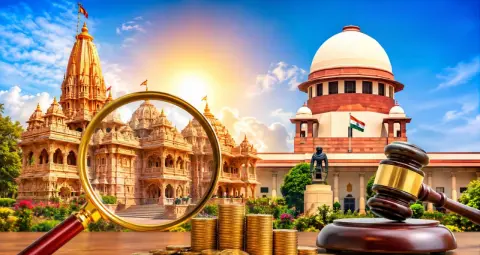
The Supreme Court, with Chief Justice of India Surya Kant presiding, has dismissed a petition seeking judicial reforms in its entirety.
The petition sought the constitution of a committee, mandatory disposal of every case within 12 months, and scrutiny of certain categories of cases. Rejecting the plea, Chief Justice Surya Kant observed that such matters should not be raised through petitions filed for publicity and that approaching the court in this manner was inappropriate.




Addressing the petitioner, the Chief Justice stated that any proposal for judicial or administrative reforms should be submitted in writing. He clarified that suggestions could be evaluated administratively to assess their feasibility. He observed that the court would not entertain petitions presented in the name of judicial reforms.
The Chief Justice advised the petitioner to send suggestions through a written communication instead of filing a petition. He stated that administrative suggestions were always welcome and did not require invocation of the court’s jurisdiction.
The court cautioned against filing petitions merely to speak before cameras, noting that some individuals file such petitions only for publicity. The Chief Justice advised that suggestions for reforms could always be conveyed in writing.
In its order, the court recorded that the petition had clubbed together several unrelated issues, rendering it untenable and leading to its dismissal. It noted that the appropriate course for conveying administrative suggestions was to address them directly to the Chief Justice.
The Chief Justice reiterated that filing a petition was unnecessary for offering suggestions on administrative aspects and that such proposals could be submitted separately and would be considered.
On the demand that every court must decide every case within one year, the Chief Justice questioned the practicality of such a proposal and asked how many courts would be required to achieve such timelines.
The Chief Justice also cautioned that petitions in the name of judicial reforms should not be misused for publicity or media attention. He reiterated that the court’s purpose was to administer justice, not to facilitate publicity.
Emphasising the proper procedure for judicial reforms, the Chief Justice stated that media publicity was not required to bring about changes and that written suggestions could be sent for evaluation, following which feasible measures could be implemented.