
Amid the flood situation in Bihar, the state government has decided to provide immediate financial assistance to affected families. Chief Minister Samrat Choudhary will transfer ₹7,000 each to the bank accounts of flood-affected families through Direct Benefit Transfer (DBT) on Tuesday.
The Disaster Management Department had prepared the details of 8,27,472 affected families by Monday evening. A total of ₹579.23 crore in ex-gratia assistance is to be provided to these families.
This is the first time this year that flood-affected families are being provided cash assistance of ₹7,000 directly into their bank accounts.
According to government figures, around 49.36 lakh people across 575 gram panchayats in 88 blocks of 15 districts have been affected by the floods in some way.
The affected districts are Patna, Bhojpur, Saran, Vaishali, Bhagalpur, Begusarai, Buxar, Samastipur, Munger, Katihar, Lakhisarai, Khagaria, Purnia, Madhepura and Araria.
Continuous rainfall and rising river levels have kept the situation challenging in low-lying and diara areas of these districts.
The ₹7,000 assistance announced by Chief Minister Samrat Choudhary is intended to provide immediate financial support to flood-affected families. Flooding can increase financial pressure on households as water enters homes, damages household goods, affects employment and raises spending on daily necessities.
The Disaster Management Department sought information continuously from affected districts to compile beneficiary details. By Monday evening, details of 8,27,472 families had been prepared. Based on these details, preparations were made to transfer ₹579.23 crore through DBT.
The government is seeking to ensure that the relief amount reaches beneficiaries directly in their bank accounts, reducing the possibility of problems or delays at intermediate levels.
One of the biggest challenges during the floods is that rivers continue to flow around or above their danger marks at several locations. According to Central Water Commission data, water levels in several major rivers, including the Ganga, Kosi, Burhi Gandak, Punpun and Bagmati, remain above the danger mark at several places.




Water levels have started declining at some locations, but the flood threat has not completely ended.
A decline in the Ganga's water level has been recorded at Sultanganj in Bhagalpur, but river water remains a concern in other parts of the state. The Kosi is above the danger mark at Baltara and Kursela. The water level of the Burhi Gandak in Khagaria has also been reported above the danger mark.
The Ganga is flowing above the danger mark at Digha Ghat, Gandhi Ghat and Hathidah in Patna, as well as in Bhagalpur, Kahalgaon and Munger. The Punpun at Sripalpur and the Bagmati at Benibad are also above their respective danger marks.
Relief and rescue operations are continuing in the flood-affected areas. Community kitchens are providing food to people in affected locations. According to available figures, around 1,260 community kitchens are operating, through which around 1.19 crore people have so far been provided meals in the morning and evening.
Relief camps have also been established, where food, accommodation and medical facilities are being provided according to requirements.
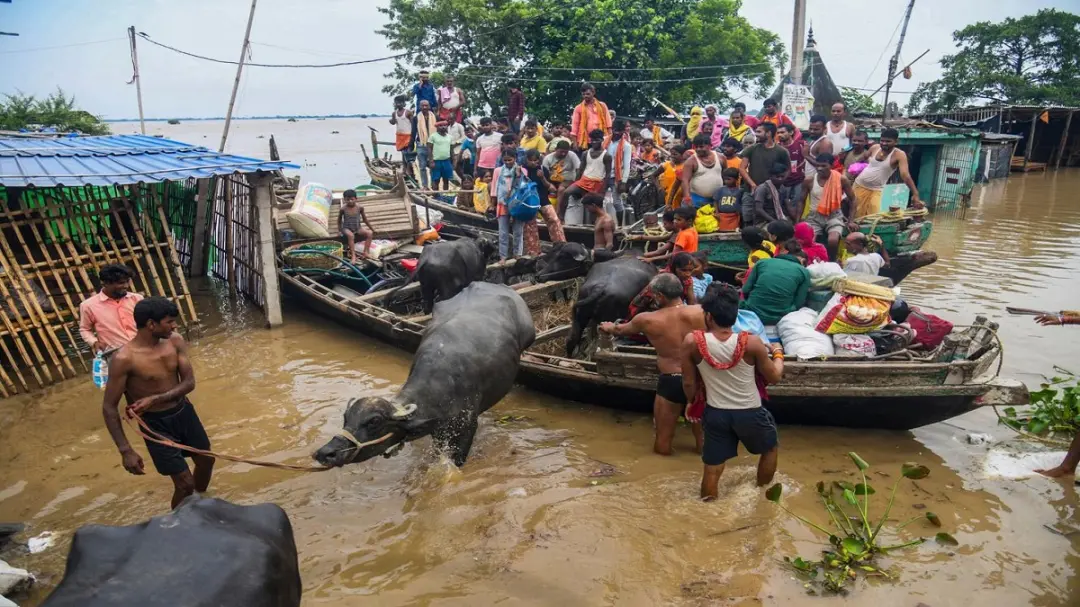
A large number of boats have been deployed to facilitate movement and rescue operations in flood-affected areas. The boats are helping authorities reach villages where road connectivity has been affected or where water has accumulated on all sides.
Teams of the National Disaster Response Force (NDRF) and State Disaster Response Force (SDRF) are also deployed in different areas. Arrangements have been made to immediately send rescue teams when information is received about a sudden rise in water, the need for a boat or families being stranded.
The impact of the floods is not limited to homes. Waterlogging in agricultural fields has created a risk of crop damage. Arrangements for fodder and drinking water for livestock have also become a challenge in rural areas.
In several places, people have had to take shelter with their cattle in higher locations. The government therefore also has the responsibility of protecting livestock and ensuring the availability of fodder along with safeguarding the human population.
Chief Minister Samrat Choudhary has previously conducted an aerial survey of flood-affected areas and reviewed relief and rescue operations with officials.
The state government has instructed administrative officials in vulnerable districts to maintain continuous surveillance. Special attention has been directed towards embankments, areas along rivers and low-lying regions during the floods.
The flood situation in Bihar has emerged at a time when rainfall in September has affected river levels in several areas. Recent reports have stated that around 50 lakh people in 15 districts of the state have been affected by the floods.
Continuous rainfall over the past few days and rainfall in catchment areas of Nepal have also been linked to the flood situation.
Although water levels in some parts of the state have gradually started declining, the administration does not yet consider the threat to have completely passed. Even after floodwaters recede, waterlogging can continue in low-lying areas. In several places, roads and connecting routes may remain submerged, delaying the restoration of normal movement. The risk of erosion can also increase as water levels fall.
Monitoring of embankments and vulnerable sections along rivers has also been increased. The Water Resources Department has instructed officials to reach the spot and assess the situation immediately if information is received about erosion or damage to an embankment.
Officials have also been asked to keep machinery and other resources ready so that local rescue operations can begin if water pressure suddenly increases.
The rising water level of the Ganga in Patna has remained a particular concern. The administration is keeping a close watch on riverbank areas and diara regions of the capital.
Previously, after the Ganga flowed above the danger mark in Patna, the administration had increased monitoring of embankments and vulnerable areas.
Families whose daily livelihoods depend directly on local markets, agriculture or wage labour face particular difficulties during floods. As water levels rise, work can stop and household income can be disrupted.
Families may also have to move stored grain, clothing and other belongings to safer locations. Direct financial assistance from the government can help affected families meet immediate needs during such circumstances.
The transfer of ₹7,000 through DBT is an important part of the relief process. Direct payment into bank accounts means beneficiaries do not have to visit different government offices to receive the relief amount. However, local administration will also need to address any problems related to bank accounts or documents for affected families.
Health services also face increased pressure in flood-affected areas. Prolonged waterlogging can increase the risk of contaminated drinking water, mosquito-related problems and waterborne diseases.
The availability of clean water, toilets, medicines and regular health checks at relief camps is therefore an important part of the relief arrangements. Children, elderly people and pregnant women may require special medical assistance.
Providing fodder for livestock is similarly an essential part of relief operations. In flood-affected villages, many people do not want to leave their cattle behind when moving to safer locations. Relief agencies therefore need to provide fodder and safe places for animals along with facilities for the human population.
Along with addressing the immediate flood crisis, the state government has also spoken about work on the river system and flood management to provide a permanent solution to such situations in the future.
Chief Minister Samrat Choudhary has emphasised the need for a permanent solution to the flood problem.
Flooding in Bihar every year is linked in large part to river levels, heavy rainfall, water coming from catchment areas of Nepal and the local drainage system. Measures such as monitoring embankments, assessing riverbed conditions, improving drainage, controlling erosion and maintaining advance preparedness in vulnerable areas are also required.
The challenge for the government this time is to continue relief and rescue operations while preparing a long-term strategy for future floods.
The ₹7,000 immediate assistance is a relief measure for affected people, while further steps related to rehabilitation and compensation for losses will remain important given the impact on the daily lives of millions of people.
Weather conditions have also not returned completely to normal. Several parts of Bihar are expected to receive rainfall in the coming days. Continuous monitoring of river levels will therefore remain necessary. If rainfall intensifies again, conditions could deteriorate in areas that are already affected by flooding.
This is why instructions are being issued to keep relief materials, boats, rescue teams and medical arrangements ready.
At present, Chief Minister Samrat Choudhary is set to transfer ₹7,000 each to the accounts of 8,27,472 families, with a total assistance amount of ₹579.23 crore to be transferred through DBT. At the same time, the administration continues to face challenges as around 49.36 lakh people in 15 districts have been affected and several major rivers are flowing above their danger marks.
Although floodwaters have started declining at some locations, the crisis has not completely ended. Along with financial assistance, affected families require food, safe accommodation, healthcare, drinking water and transport facilities. The weather and river-level conditions in the coming days will determine how quickly the situation returns to normal in Bihar's flood-affected areas.


