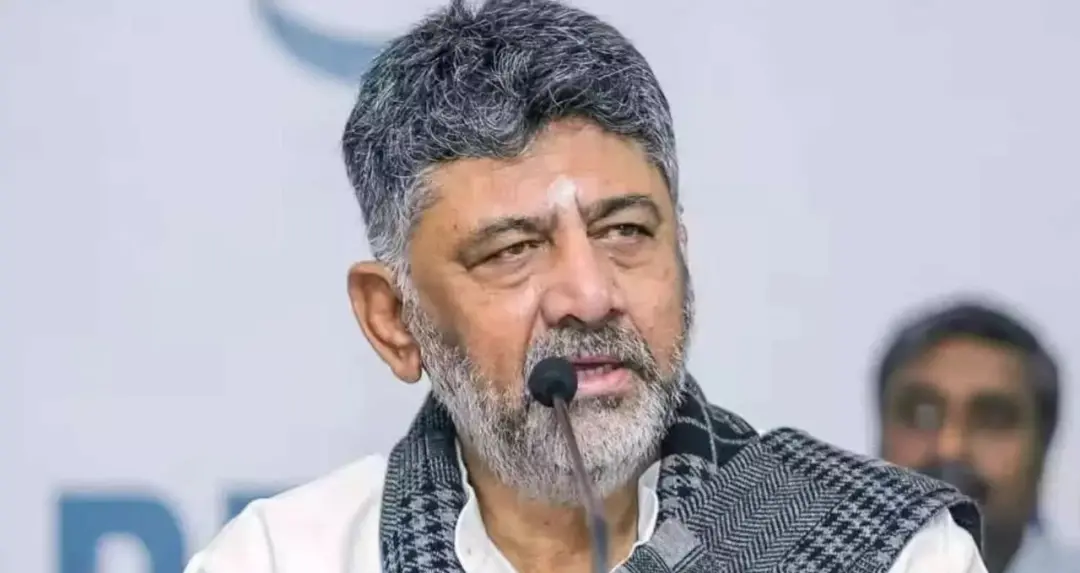
Karnataka Chief Minister D.K. Shivakumar is focusing on strengthening the Congress’s presence in coastal Karnataka ahead of the 2028 Assembly elections. The proposed Cabinet meeting in Mangaluru on September 18 is being viewed as an important part of this strategy.
Preparations for the 2028 Karnataka Assembly elections are gradually gaining momentum, with Shivakumar placing particular emphasis on the coastal region. The government’s next major activities include the Cabinet meeting scheduled to be held in Mangaluru on September 18. While the meeting is officially part of the administrative process, its political significance is also being discussed. Dakshina Kannada and Udupi have long been regarded as b electoral bases of the Bharatiya Janata Party (BJP). Against this backdrop, the Congress government’s efforts to increase administrative and development activities in the coastal region are being viewed as part of a broader political strategy ahead of the 2028 Assembly elections.
Mangaluru is the headquarters of Dakshina Kannada district and holds an important position in the politics of coastal Karnataka. The BJP and the Rashtriya Swayamsevak Sangh (RSS) have built a b organisational and ideological base in the region over several decades.
Dakshina Kannada and Udupi together have 13 Assembly seats, comprising eight in Dakshina Kannada and five in Udupi. In the 2023 Assembly elections, the BJP won 11 of these 13 seats. The party won all five seats in Udupi and six seats in Dakshina Kannada. The Congress won only two seats.
However, the electoral history of the region has not been entirely one-sided. In the 2013 Assembly elections, the Congress won 10 of the 13 seats in the coastal region. The BJP subsequently rebuilt its position in the area. For the Congress, the 2013 result indicates that electoral equations in coastal Karnataka can change.




The Congress returned to power in Karnataka in the 2023 Assembly elections with 135 seats. The party’s electoral strategy included the social coalition associated with then Chief Minister Siddaramaiah and AHINDA politics. AHINDA is broadly considered to include minority, backward-class and Dalit communities.
Shivakumar’s challenge is now not limited to retaining the gains made in 2023. The party will need to expand into new political areas to increase its Assembly seat tally in 2028. Coastal Karnataka could be an important area for such expansion.
According to Bengaluru-based political journalist Prashant Natu, the BJP has maintained a b position in Dakshina Kannada and Udupi for nearly three decades. He said the decision to hold a Cabinet meeting in Mangaluru could be part of an effort to reach out to voters who have supported the BJP for a long period.
Shivakumar’s broader political strategy also includes efforts to increase outreach among sections of the Lingayat community. The Lingayat community has traditionally been regarded as an important support base of the BJP in Karnataka politics.
According to Prashant Natu’s assessment, the Congress could seek to challenge the BJP on two separate fronts. One could involve efforts to increase Lingayat support in central and northern Karnataka, while the other could focus on weakening the BJP’s b base in coastal Karnataka.
The Congress faces a different challenge in the coastal region, however. The BJP’s influence there is not limited to electoral performance but is also linked to a long-established organisational, social and ideological network.
For the Congress, the most practical strategy in coastal Karnataka may not be to change the BJP’s entire political base at once, but to make some of its b seats competitive.
If the Congress succeeds in making contests tougher in some seats traditionally considered safe for the BJP, its overall seat position could improve in the 2028 elections. This means reducing the BJP’s winning margins in some constituencies could also represent an important political gain for the Congress before it seeks to win those seats.
Shivakumar’s coastal strategy is not expected to be limited to ideological or political messaging. Development, tourism, infrastructure and employment could form the principal basis of the Congress government’s outreach in the region.
The state government has directed various departments to identify proposals related to coastal Karnataka that could be considered during the Cabinet meeting in Mangaluru. This could also link the administrative agenda of the meeting to regional development.
Tourism is also among the government’s priorities. During his tenure as Deputy Chief Minister, Shivakumar had announced plans to prepare a separate tourism policy for the coastal region.
The Karnataka Tourism Department’s ‘Brand Karavali’ initiative has emerged as a broader roadmap for development in the coastal region. It refers to a development programme involving around ₹1,260 crore.
By focusing on tourism and economic development, the Congress could seek to establish a distinct political narrative in coastal Karnataka. The region has long been associated with identity- and ideology-based politics. In this context, promoting issues such as employment, investment, tourism and infrastructure could provide the Congress with a platform for an alternative political message.
It remains unclear how significantly Shivakumar’s strategy will alter the political map of coastal Karnataka. The BJP’s strength in Dakshina Kannada and Udupi is not limited to a single government or electoral cycle. The party has developed a b organisational network and ideological base over decades.
For the Congress, however, the 2013 election remains an important example. The party demonstrated in that election that electoral equations in coastal Karnataka are not necessarily permanent by winning 10 of the region’s 13 seats.
The Congress’s immediate objective may therefore be not to bring about a change of power across the entire region, but to make electoral contests more competitive in BJP bholds. The September 18 Cabinet meeting in Mangaluru could become an important step in that broader strategy.
Ahead of the 2028 Assembly elections, Shivakumar will need to build a new coalition beyond the social and political equations that contributed to the Congress’s 2023 victory. The party’s increased activity in coastal Karnataka appears to form part of that broader strategy, as it seeks to challenge the BJP’s long-established base in the region.