The Election Commission of India on Tuesday told the Supreme Court that its order providing for Special Intensive Revision (SIR) of electoral rolls in various states is legislative in nature. The Commission stated that the order lays down clear guiding principles and specifies the required set of documents, with the objective of correcting errors in electoral rolls and ensuring valid voter registration to enhance the fairness and transparency of elections.
The submission was made through an affidavit placed before the Supreme Court during the final hearing of multiple petitions challenging the SIR exercise.

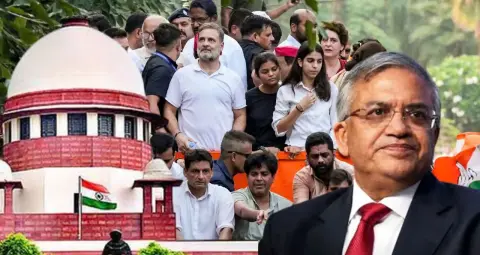
Appearing for the Election Commission, senior advocate Rakesh Dwivedi advanced submissions before a Bench comprising Chief Justice Surya Kant and Justice Joymalya Bagchi. Dwivedi submitted that the SIR order is applicable across the country, except in the case of Assam. He stated that the order prescribes clear guiding principles and a defined set of documents, and that it constitutes a general procedure aimed solely at ensuring correct and valid entries in the electoral rolls.
The petitions before the Court have challenged the SIR process in several states, including Bihar. Among the principal petitioners is the non-governmental organisation Association for Democratic Reforms. The petitions raise constitutional issues relating to the scope of the Election Commission’s powers, the determination of citizenship for electoral purposes, and the fundamental right to vote.
Dwivedi submitted that there are clear legal schemes governing the preparation and revision of electoral rolls and the regulation of elections. He referred to Section 62 of the Representation of the People Act and submitted that voter registration is subject to specific statutory conditions. He further relied on Articles 324 to 326 of the Constitution and Section 19 of the Representation of the People Act, 1950, to submit that only citizens are entitled to be registered as voters.
He submitted that the framers of the Constitution intended that the right to vote be conferred only on eligible citizens. He clarified that the SIR process is not premised on the assumption that every voter must necessarily produce documentary proof. According to the Commission, the purpose of the exercise is confined to preparing accurate and valid electoral rolls and ensuring transparency in the electoral process.
The Election Commission stated that the objective of Special Intensive Revision is to eliminate errors and irregularities in electoral rolls, including the removal of deceased voters, duplicate registrations, and other illegal entries. It asserted that revisions under the SIR are carried out strictly in accordance with prescribed guiding principles and valid documents.
The Commission further submitted that it has a constitutional obligation to ensure that only citizens are included in the electoral rolls and that it is vested with adequate powers under the Constitution and statutory law to discharge this duty. It stated that the SIR process is uniformly applicable across the country to prevent discrimination or inequality among states.
The Supreme Court heard the affidavit and submissions during the course of the final hearing of the petitions. The Commission maintained that the SIR order is legislative in character and contains adequate safeguards to ensure electoral transparency and the protection of voter rights.