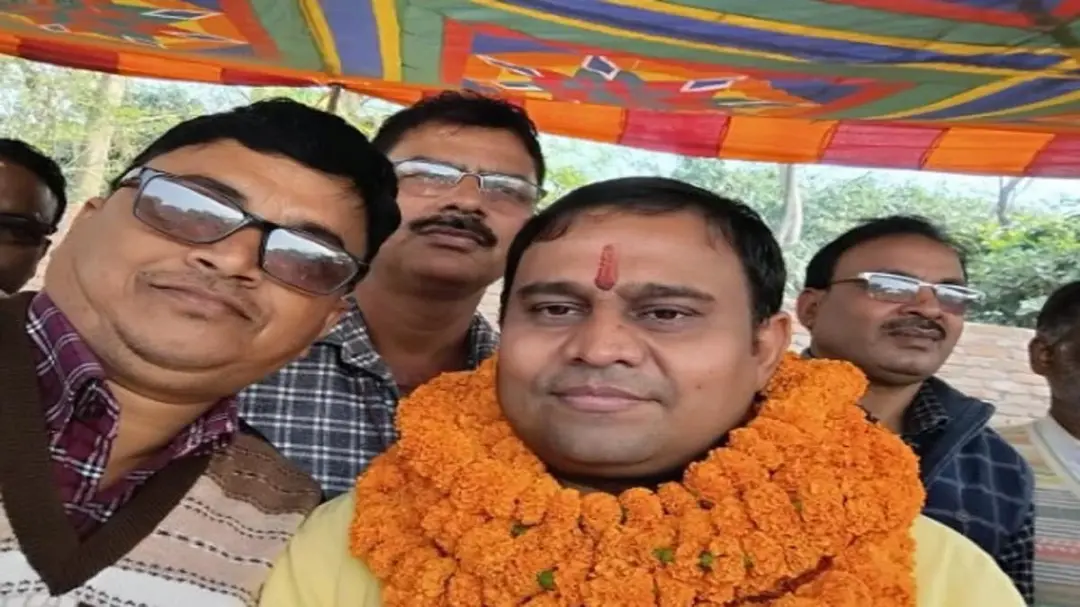
A fresh political dispute has emerged in Bihar over RO plants installed in government schools in Muzaffarpur. Abhishek Kumar Jha, NDA candidate from the Tirhut Graduate constituency and state spokesperson of the Janata Dal (United), has launched a sharp attack on Legislative Council member Banshidhar Brajwasi, alleging that serious questions have arisen over the money spent on the purchase and installation of 66 RO systems in government schools under the Chief Minister Area Development Scheme.
Abhishek Jha said that Banshidhar Brajwasi, who earlier sought accountability from the government and officials over alleged irregularities in government schemes, should now also answer the public when questions are being raised over a scheme linked to his recommendation. In this context, Jha referred to Brajwasi as “another Kejriwal” in a sarcastic remark. The comment is part of the political allegations and counter-allegations, and the allegations made in the matter are yet to be investigated.
According to Abhishek Jha, a recommendation was made for spending up to around Rs 50 lakh for installing 25-litre-capacity drinking water purifier chiller systems in government schools in Muzaffarpur and Sitamarhi. According to the available report, the average cost of the systems installed in 66 schools comes to approximately Rs 75,758 per system.
Jha claims that machines of similar capacity and quality are available in the market at considerably lower prices. On this basis, he has demanded an examination of the purchase process, tender, supply order, bills, payment vouchers and quality certificates.
The JD(U) leader questioned that if government funds were spent on installing the RO plants according to the rules, there should be no difficulty in making the complete process documents public. He said transparency is the most important requirement in any development work undertaken with public money.
According to Jha, answers should be provided on the total cost of the scheme, the actual purchase price of the machines, the agency or supplier from which the equipment was purchased, the tender process followed, the number of payments made and the level at which the quality of the systems installed in the concerned schools was examined.
Abhishek Jha has linked the issue to Banshidhar Brajwasi’s earlier political position. He said that when Brajwasi was associated with the teachers’ movement and later served as a member of the Legislative Council, he had raised questions over alleged irregularities in other development works and demanded transparency and investigations.
Jha said that now that a scheme involving recommendations linked to Brajwasi’s MLC fund has come under question, Brajwasi should similarly clarify the situation with supporting documents. According to a Hindustan report, Jha has demanded that Brajwasi produce documents related to the expenditure, including the bill, tender and BOQ, and said that one week’s time should be given for a response.
Another important aspect of the dispute concerns the quality of drinking water being provided to children in government schools. Abhishek Jha has not only demanded an investigation into allegations of financial irregularities but has also sought independent laboratory testing of the water produced by the RO systems.
His argument is that if drinking water facilities have been provided for children in schools, it is necessary to ensure that the machines are functioning properly and that the water supplied through them meets the prescribed quality standards.




He has demanded that all RO plants installed in Muzaffarpur and Sitamarhi be examined by an independent technical agency. He has also called for scrutiny of the financial records related to the purchase and installation of each plant.
Jha said that if an investigation finds that the equipment is of poor quality or that an impermissible difference exists between the payments made and the actual market price, recovery of government funds from those responsible and action according to the rules should follow.
He has also demanded that the investigation not remain limited to the two districts and instead be extended to RO systems installed across Bihar under the Chief Minister Area Development Scheme.
Abhishek Jha has pointed to what he described as a substantial difference in the prices involved. According to him, the market price of some RO systems is being stated at around Rs 12,000 to Rs 15,000, while the claim is that Rs 75,000 to nearly Rs 1 lakh was spent per machine under the government scheme.
However, the reason for this difference can only be established through an independent investigation. It is not clear from the material provided whether the expenditure included, apart from the machine itself, installation, chiller systems, transportation, structural work, warranty, servicing or other components.
Therefore, a distinction must be maintained between allegations and established evidence in the matter.
In government procurement, the market price of an equipment item and the total cost of a government project are not always identical. Costs related to installation, electrical fittings, pipelines, stands, water connections, transportation, technical services and warranty may also be included along with the supply of a machine.
However, if there is an unusual difference between the sanctioned amount of a project and the actual cost of the materials, scrutiny of the procurement process becomes relevant. On this basis, Abhishek Jha has demanded that documents such as the tender and BOQ be made public.
The key documents in the dispute are expected to include the tender, BOQ, supply order, bills, payment vouchers and quality certificates. If these records provide a clear breakdown of the purchase price of the machines, installation costs and payments made, it would be possible to determine the actual expenditure per RO system.
An independent technical examination could similarly establish whether the systems installed meet the prescribed capacity and quality requirements.
The present condition of the RO plants installed in schools could also form an important part of any investigation. Comparing only the purchase price with the market price would not be sufficient.
It would also be necessary to examine how many schools actually have functioning machines, how many locations are receiving water regularly, who is responsible for maintenance, when the filters were replaced and whether the quality of the water has been tested periodically.
If the objective of the scheme is to provide safe drinking water to children, its outcome would also need to be assessed on these parameters.
The controversy has political significance in the context of activity in the Tirhut region. Banshidhar Brajwasi has been associated with the teachers’ movement in the region and later became a member of the Legislative Council.
In the 2024 by-election to the Tirhut Graduate constituency, he won as an independent candidate. Following his victory, he emerged as a prominent independent political figure in Bihar politics.
Now, amid the upcoming political contest in the Tirhut Graduate constituency, a fresh round of statements between Abhishek Jha and Banshidhar Brajwasi has emerged. Jha is contesting as the NDA candidate, while Brajwasi has already been active in the constituency.
As a result, the RO plant dispute has become a subject of political debate in addition to the demand for an investigation into the government scheme.
Through his allegations, Abhishek Jha has raised the question of whether accountability in the use of public funds should apply equally to everyone.
He said that whether a person is from the ruling side or the opposition, a public representative or an official, anyone through whom government funds are spent should be accountable for the expenditure. On this basis, he has demanded that Brajwasi make all documents related to the RO scheme public.
Jha also said that he was not directly declaring any individual corrupt but was demanding an independent investigation into the expenditure and process associated with the scheme.
This distinction is relevant because any final conclusion regarding financial irregularities can only be reached on the basis of documents, technical examination and an investigation by the concerned department. At present, the allegations made by Abhishek Jha remain at the level of political statements and a demand for an investigation.
Abhishek Jha’s demand for an investigation into RO plants installed across Bihar under the Chief Minister Area Development Scheme expands the scope of the dispute.
If the government orders an investigation on this demand, the purchase and installation processes for systems installed in districts other than Muzaffarpur and Sitamarhi could also come under scrutiny.
Such an investigation could establish whether the issue is limited to a single project or whether there is a broader process-related issue concerning the purchase of drinking water equipment for government schools.
The position of Banshidhar Brajwasi is also important in the matter. If he makes public the tender, BOQ, sanction order, payment details and technical information about the machines, the allegations could be examined more clearly.
Similarly, if he explains which components were included in the expenditure per machine and under which prescribed procedure the purchase was carried out, it could help establish the factual position amid the political dispute.
The controversy in Muzaffarpur has emerged at a time when political activity in the Tirhut Graduate constituency is already underway.
During an election environment, issues involving government schemes, educational institutions and development works can become subjects of discussion among voters. The issue involving the 66 RO plants is therefore also being raised in the political debate between the two sides.
At present, the allegations made by Abhishek Jha centre on three key questions: the procedure under which the RO systems were purchased using government funds, the actual cost per system and the quality of the equipment installed.
A final answer to these questions can only come through an independent financial and technical investigation. If an investigation finds that the process fully complied with the rules, the allegations would not be substantiated. If serious financial or technical irregularities are found, the question of fixing responsibility would arise.
The dispute has also brought renewed attention to whether information on expenditure and quality should be publicly available for works undertaken through the development funds of elected representatives.
Transparency assumes particular importance in projects involving schools because such schemes are directly connected with facilities for children and the government education system. In this case, a document-based investigation, separate from the political allegations, will determine whether any financial irregularity actually occurred in the purchase of the 66 RO systems.