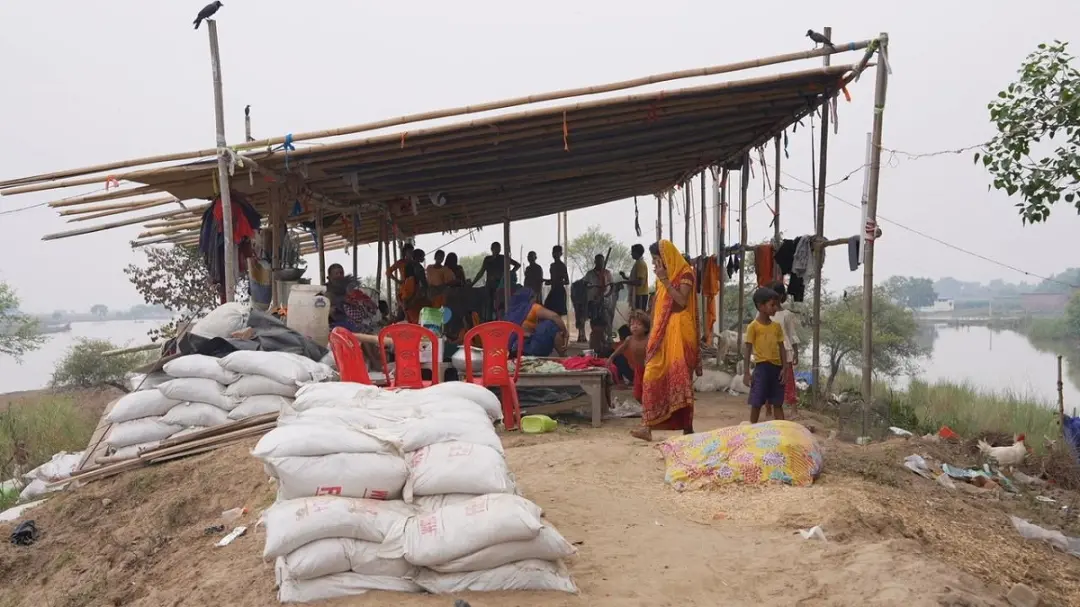
In Bhojpur, Ganga erosion has affected more than land along the riverbank, forcing families who spent years building homes, securing their children’s future and accumulating property for coming generations to watch their houses disappear into the river. In Jawaninia village of Shahpur block, rapid erosion left several families displaced, while farmland, household belongings, trees, religious sites and long-standing village memories were also lost to the river. According to a July 2025 report, more than 150 houses in Ward Nos. 4 and 5 of Jawaninia village had already been submerged by the Ganga, with erosion continuing.
For families who built their homes brick by brick, one of the most difficult moments came when they realised that saving the house was no longer possible. Some tried to remove their belongings, while others focused on moving children and elderly family members to safer locations. People collected trunks and clothes, tried to save essential documents and moved livestock to safety. However, the speed of the erosion meant that several families did not get enough time to remove even their essential belongings from homes where they had lived for years.
The scale of the distress in Jawaninia was reflected in the fact that homes once regarded as the foundation of a secure future for children became part of the Ganga’s flow. According to local residents, land was continuously slipping away in several parts of the village. House foundations were weakening, leaving residents constantly worried about which house would be next. The river water and b current continued cutting into the soil along the bank, causing several homes to collapse into the Ganga.
One local resident said that several generations of their family had lived in the village. The family had built its house after saving money for years. According to the report, one villager had spent around Rs 16 lakh to construct an 11-room house on more than one and a half kattha of land. After the erosion, the house was lost to the Ganga, forcing the family to live around the embankment. The loss involved not only the house but also years of the family’s work, savings and plans for the future.
For villagers, their homes were more than places to live. Children were born there, elderly family members spent their lives there, weddings were held and festivals were celebrated. Children played in the courtyards, while the surrounding land provided livelihoods for families. Ganga erosion took several of these things away at once. Families whose agricultural land had already been lost to the river then faced the challenge of protecting their homes. Once their houses were also lost, many were left without even a secure place from which to begin their lives again.



The situation in Jawaninia was not limited to damage to houses. Several religious and public sites also came under threat from the erosion. The report mentioned the Ghuruhu Brahm Baba Temple, Vrikshdand Brahm Baba Temple, Govardhan Temple and Maa Kali Temple among the sites that were lost to the Ganga. The water tank of the tap-water supply scheme and large trees were also affected by the erosion. The changing river course therefore affected the village’s physical infrastructure as well as its social and religious identity.
The biggest concern for families affected by erosion is where they will go. Moving away from the riverbank does not simply mean changing houses. It can mean greater distance from farmland and employment, changes in children’s schools and separation from established social networks. Residents of the village have traditionally supported one another during difficult times, but displacement can scatter families across different locations. Rehabilitation therefore involves more than simply providing land.
Villagers have long demanded a permanent solution. They have maintained that immediate relief or temporary safe accommodation would not provide a lasting answer. They have sought b and technically effective protection measures in areas affected by Ganga erosion so that the remaining settlement can be protected from the river. Their demands have included boulder pitching, b spurs and other erosion-control measures.
For people living along the Ganga, one of the biggest concerns is the difficulty of predicting when and in which direction erosion will intensify. Rising river levels create the risk of flooding, while rapid erosion can also begin in several places after water levels fall. When the soil along the riverbank becomes weak, the current can continue cutting inward. Land that residents considered safe for their homes and fields only days earlier can therefore become vulnerable.
Residents of Jawaninia also said that a large part of the village had already been lost to the Ganga. According to a local representative, Ward Nos. 4 and 5 of Damodarpur panchayat had a population of around 2,500 people, with a large number of families affected by erosion. Villagers demanded that instead of receiving only financial assistance, they should be provided houses at a safe location because not every family has the capacity to rebuild a home.
The impact of erosion is particularly difficult for poor and low-income families. Those without alternative land or a house in a city can become homeless when their homes are destroyed. Such families may have to live in relief camps, on embankments, along roads or at relatives’ homes. The difficulties increase during the monsoon, when temporary accommodation is particularly difficult for children, women and elderly people.
The loss of household belongings is also substantial. Clothes, utensils, furniture, food grains, essential documents, agricultural equipment and other items accumulated over years can suddenly be swept away. Many families do not have enough time to move their belongings to safety. Once water and erosion reach the foundation, an entire house can become unsafe within a short period.
During the erosion in Jawaninia, some houses were completely lost to the river while several others came under threat. The administration and officials associated with flood control began relief and rescue operations. The presence of officials and the distribution of relief materials were used to address the immediate crisis, but residents remained concerned that the river could again threaten them unless permanent protection measures were put in place.
The problem is not limited to Bhojpur. Incidents of erosion affecting houses and agricultural land have also been reported in other districts along the Ganga in Bihar in recent years. In August 2026, 15 houses in English village of Bhagalpur were swept into the Ganga in a single night because of rapid erosion. Members of one family heard the sound of part of their house collapsing at night and escaped to save their lives, while their household belongings were swept into the river.
In that Bhagalpur incident, residents also said that their agricultural land had first been lost to erosion and their houses were subsequently affected. The administration said it would identify affected families, facilitate government assistance and provide essential items. The incident also showed how Ganga erosion in several areas can gradually move from agricultural land to residential homes.
For erosion-affected families in Bhojpur, the immediate questions are how to protect the land that remains and where to permanently settle people whose homes have already been lost. Relief and rescue operations can address immediate needs, but a concrete rehabilitation arrangement is required to provide displaced families with long-term safe and dignified living conditions.
Rehabilitation after erosion raises several issues simultaneously, including land, housing, roads, electricity, water, schools, healthcare facilities and employment. If a family is given only land without access roads, drinking water and other essential facilities, starting a new life there can be difficult. The problem faced by erosion victims therefore requires a multi-dimensional approach.
The lives of people living along the Ganga are closely connected to the river. The river provides water for agriculture, the surrounding land supports livelihoods and generations of families have lived in these villages. But when the river changes course, the same river can become the greatest threat to those communities. This dual role adds to the difficulties faced by families affected by erosion.
For villagers, one of the most difficult aspects is that they want to make every possible effort to save their homes, but their ability to resist the river is limited. They fill soil, place sacks, move belongings and send children to safer locations, but when erosion accelerates, an entire stretch of land can shift within a short time. Several families have attempted protective measures on their own, but permanent protection requires administrative and technical intervention.
The story of families displaced by Ganga erosion in Jawaninia involves the loss of years of work and the need to start life again. People who once expected their homes to provide security for the next generation are now forced to consider where they will spend the next night. Children’s education, household expenses and daily necessities can all become uncertain suddenly.
Some of the greatest losses are the aspirations that are difficult to record in government statistics. A father may have planned to build a larger house for his children, a mother may have accumulated belongings for her daughter’s wedding, or a family may have built a permanent house using earnings from its farmland. When the river takes away the house and belongings, families can be left with memories and concerns about the future.
The situation in erosion-affected villages needs to be addressed beyond the immediate disaster period of flooding. In areas where the river cuts into land every year, long-term planning is required for erosion monitoring, identification of families at risk, timely relocation to safe locations and permanent rehabilitation. Where technically feasible, erosion-control works also need to be carried out using scientific methods.
The experience of Ganga erosion victims in Bhojpur shows that when a house disappears into the river, it is not only bricks and concrete that are lost. A family’s savings, farmland, livelihood, children’s future and years of memories can also disappear with it. For these families, the need extends beyond immediate relief to a permanent solution that enables them to rebuild their lives and avoid facing every monsoon with uncertainty over whether their homes will still be there the following morning.