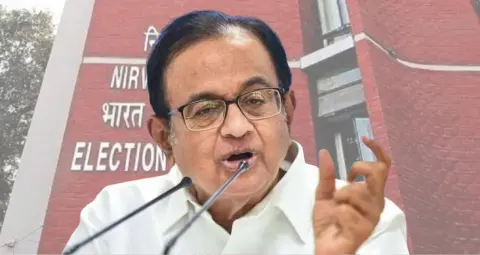
The Supreme Court on Monday declined to pass an interim order seeking the immediate suspension of Chief Election Commissioner Gyanesh Kumar. However, the court issued notices on petitions alleging that several decisions related to the Special Intensive Revision (SIR) were taken without the consent of the other two Election Commissioners. The court sought a clear and transparent response from the Election Commission on the matter.
The bench comprising Chief Justice Surya Kant, Justice Joymalya Bagchi and Justice V. Mohan heard the matter. The petitioners sought to remove Gyanesh Kumar from the functioning of his office, quash the alleged unilateral decisions related to SIR and order an independent investigation into the matter.
The case concerns questions raised over Election Commission decisions related to the SIR process. The petitioners have alleged that around 14 decisions concerning SIR were taken by Chief Election Commissioner Gyanesh Kumar without the consent of the other two Election Commissioners.
According to reports, Election Commissioners Sukhbir Singh Sandhu and Vivek Joshi formally raised objections at least 14 times over SIR-related decisions and orders during the past 10 months. The petitions rely on these allegations to seek judicial scrutiny of the Election Commission's decision-making process.
The petitioners have sought the cancellation of decisions allegedly taken unilaterally. They have also sought action against Gyanesh Kumar and an independent investigation into allegations concerning the removal of names from electoral rolls during the SIR process.
One petition seeks the constitution of an independent judicial inquiry commission or a special investigation team. It also seeks examination of Election Commission records and the relevant electronic systems.
The petitioners further sought that the CEC be kept away from exercising the powers of his office until a final decision is delivered. The Supreme Court, however, declined to order his immediate suspension.




During the hearing, senior counsel for the petitioner sought the immediate suspension of the CEC or restrictions on his powers. The bench asked who would conduct elections if the CEC were suspended.
The court also made it clear that it could not proceed on the basis of media reports alone to assume that all the relevant decisions of the Election Commission were taken unilaterally. While seeking responses from the Election Commission and the other parties, the court said it could determine whether the law had been violated only after the records were placed before it.
The CJI indicated that if the records establish that a decision was not taken in accordance with the prescribed legal procedure, the court could quash or render that decision ineffective.
The petitioners raised concerns in court regarding the credibility of the Election Commission. They argued that transparency and adherence to the procedure of a multi-member commission were necessary in decisions related to an important electoral exercise such as SIR.
The petitioners also argued that immediate interim measures were necessary in the matter. During the hearing, counsel said that the court should pass certain interim orders, citing the seriousness of the situation.
The court, however, considered it appropriate to first seek responses from the concerned parties rather than order an immediate suspension. The Supreme Court said that if a violation of the prescribed procedure emerges from the records, it has the authority to take action against the relevant decisions.
The constitutional framework for removing the CEC and taking action against the office-holder is separate. Article 324 of the Constitution assigns the Election Commission responsibility for conducting and supervising elections.
The Constitution prescribes a special procedure for removing the Chief Election Commissioner. Under Article 324(5), the CEC can be removed through a parliamentary process similar to that applicable to a Supreme Court judge.
However, decisions of the Election Commission are not completely outside the scope of judicial review. If a decision is found to be inconsistent with law or the Constitution, the court can pass appropriate judicial orders against it.
The background to the current controversy involving Gyanesh Kumar also includes a report by The Indian Express. The report referred to differences within the Election Commission during the SIR process.
According to the report, Election Commissioners Sukhbir Singh Sandhu and Vivek Joshi had raised objections several times over the SIR-related process and decisions. The report referred to at least 14 such objections during the previous 10 months.
The petitions have cited these reported objections while questioning the Election Commission's decision-making process. The court, however, has made it clear that no final conclusion can be reached solely on the basis of media reports.
Political pressure on Gyanesh Kumar is also increasing. The opposition is preparing to bring an impeachment motion against him. Earlier, in April 2026, the opposition had also submitted an impeachment notice against him.
According to the available information, the proposal was rejected in the Lok Sabha at that time, while the matter was reported to be pending in the Rajya Sabha. The opposition is now preparing to raise the issue again in Parliament.
The Congress is leading the initiative and has held discussions with other opposition parties on the matter. The proposal is expected to be introduced within the next two weeks.
Legal questions have also emerged regarding criminal action against the CEC. Section 16 of the Chief Election Commissioner and Other Election Commissioners Act, 2023 provides protection in relation to acts performed or decisions taken in the discharge of official duties.
This means that legal protection applies against the initiation of civil or criminal proceedings against the CEC and other Election Commissioners for acts performed in the discharge of their official responsibilities. Because of this provision, taking action against the CEC solely through police action or arrest may involve legal complexities.
The ruling BJP has rejected the allegations against Gyanesh Kumar. The party's position is that objections recorded among Election Commissioners cannot, by themselves, be treated as evidence of any irregularity.
The BJP has also argued that institutional debate and differences of opinion can be part of the functioning of a democratic institution.
The most significant constitutional route for removing the Chief Election Commissioner is the impeachment process. Under Article 324(5), the prescribed parliamentary procedure must be followed to remove the CEC.
An impeachment motion requires the support of 100 MPs in the Lok Sabha and 50 MPs in the Rajya Sabha to be introduced. The presiding officer of the concerned House must then decide whether to admit the motion.
A special majority is required in both Houses for the motion to be passed. Under the current political equations, securing such support is challenging for the opposition.